Garage Door Opener Travel Limits: How to Adjust Open and Close Limits Safely
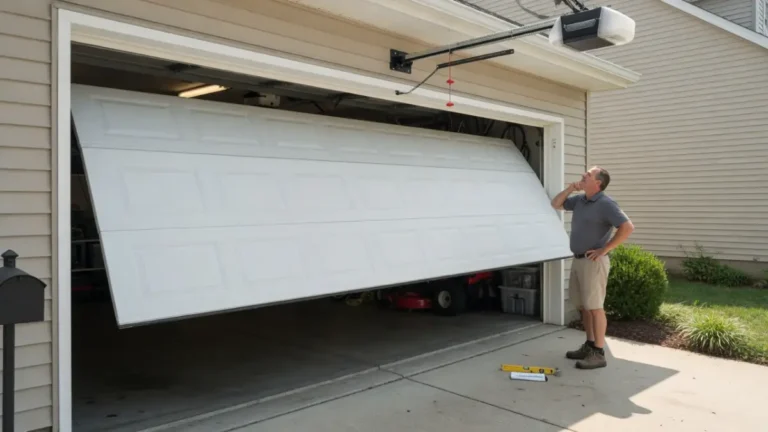
A garage door opener should stop when the door reaches its fully open or fully closed position. But sometimes the door stops several inches before reaching the floor, opens only halfway, or touches the ground and immediately reverses.
One possible reason is an incorrect garage door opener travel limit setting.
Travel limits tell the opener how far the garage door should move in the opening and closing directions. If these settings are incorrect, the opener may not complete its normal cycle.
In this guide, you’ll learn what travel limits are, what causes adjustment problems, how to identify the correct setting, and when it’s safer to call a garage door technician.
What Are Garage Door Opener Travel Limits?
Travel limits are the programmed stopping points for your garage door opener.
There are two main settings:
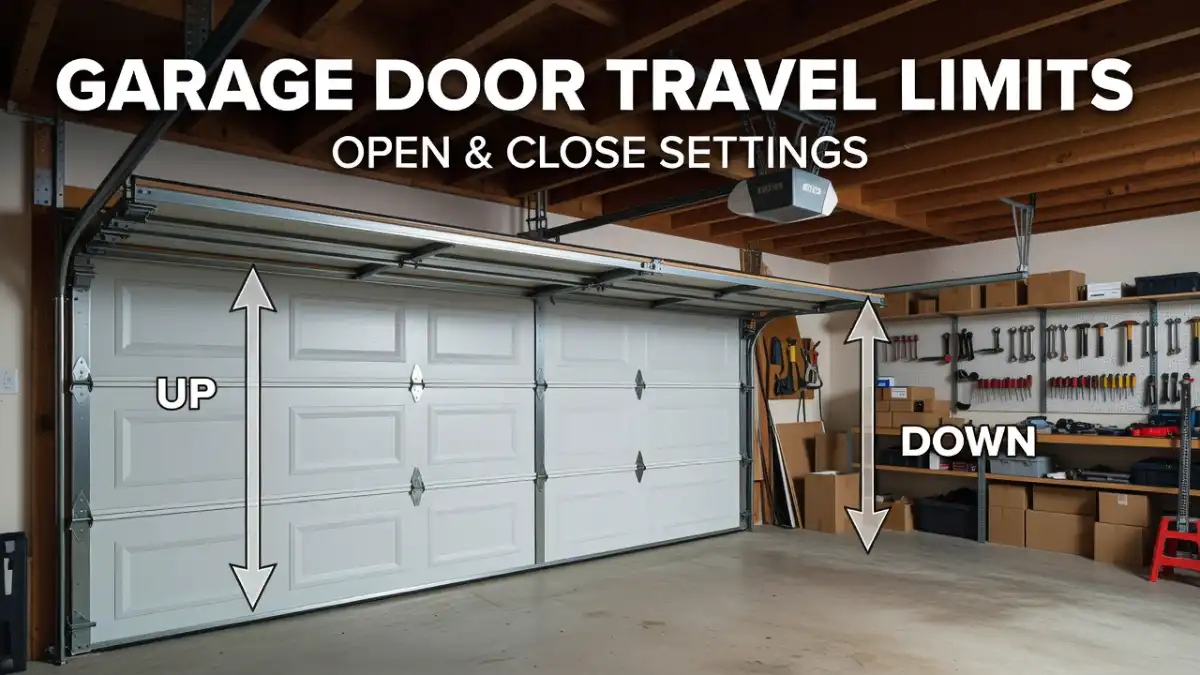
- UP Travel Limit: Determines how far the garage door travels when opening.
- DOWN Travel Limit: Determines how far the garage door travels when closing.
For example, if the UP limit is set too low, the door may stop before opening high enough for your vehicle. If the DOWN limit is incorrect, the door may stop above the floor or put too much pressure on the ground when closing.
Different garage door openers use different adjustment systems. Some older models have manual adjustment screws, while newer models may use electronic programming buttons.
Signs Your Garage Door Travel Limits May Need Attention
Look for these common symptoms:
- Garage door does not open completely: The door stops before reaching its normal fully open position.
- Garage door does not close completely: A visible gap remains between the bottom of the door and the floor.
- Door touches the floor and reverses: The opener may be detecting excessive pressure or an incorrect closing limit.
- Door stops at the wrong position: The stopping point changes after an adjustment or programming procedure.
- Opener lights flash during setup: Some models use flashing lights or beeps to indicate that travel programming has not completed successfully.
These symptoms do not always mean the travel limits are the problem. Obstructions, damaged rollers, an unbalanced door, sensor issues, and other mechanical faults can cause similar behavior.
Why Do Garage Door Opener Travel Limits Become Incorrect?
Several things can affect the door’s stopping points.
1. Incorrect Previous Adjustments
If someone changes the UP or DOWN settings without following the opener’s instructions, the door may stop too early or travel too far.
2. Door Binding or Mechanical Resistance
A garage door that sticks, has damaged rollers, or moves unevenly may not complete its travel cycle. The opener can interpret the resistance as an obstruction.
3. Incorrect Electronic Programming
On some newer openers, travel positions must be programmed again after certain repairs or setup changes. The procedure depends on the manufacturer and model.
4. Safety Sensor Problems
Misaligned, obstructed, or disconnected safety sensors can prevent the door from closing normally. This is not necessarily a travel-limit issue.
5. Garage Door Balance Problems
A heavy or unbalanced garage door puts additional strain on the opener. Travel-limit adjustments should never be used to compensate for a door that is mechanically unsafe.
How to Check Garage Door Opener Travel Limits Safely
Before changing any settings, identify the opener’s manufacturer and model number. Check the owner’s manual for the exact adjustment procedure.
Follow these preliminary checks:
Step 1: Observe a complete door cycle
Use the wall control to operate the door from fully closed to fully open, then back down. Observe where it stops and whether it reverses unexpectedly.
Step 2: Check for visible obstructions
Look for objects blocking the tracks or the door’s movement. Do not put your hands near moving parts.
Step 3: Inspect the safety sensors
Check whether the photo-eye sensors are aligned and free from dirt or obstructions. Do not bypass or disconnect the safety system.
Step 4: Identify the adjustment type
Your opener may have manual UP/DOWN adjustment screws or electronic programming buttons. Do not assume that instructions for one model apply to another.
Step 5: Follow the manufacturer’s instructions
If the manual confirms that a travel adjustment is appropriate, follow the exact model-specific procedure. Make only the adjustments specified by the manufacturer.
Do not increase the opener’s force setting just to make a sticking or unbalanced door move.
Manual vs. Electronic Travel Limit Adjustments
Garage door openers do not all use the same adjustment method.
| Opener Type | How Travel Is Set |
|---|---|
| Older manual models | UP and DOWN adjustment screws |
| Electronic models | Programming or adjustment buttons |
| Some smart openers | Model-specific electronic setup procedure |
For example, certain Chamberlain models use black and orange buttons to program the open and close positions. Other models use different buttons or adjustment controls.
The direction of rotation for manual adjustment screws can also vary by model. Always check your specific owner’s manual before turning any adjustment screw.
Important Safety Test After Any Adjustment
This is the most important part of the process.
An incorrect travel-limit adjustment can interfere with the garage door’s safety reversal system. After any adjustment, the safety reversal system must be tested according to the manufacturer’s instructions.
For many residential Chamberlain and LiftMaster models, the manufacturer’s test involves placing a 1½-inch-high object, such as a 2×4 laid flat, on the floor in the door’s path. When the closing door contacts the object, it should reverse.
However, test requirements can vary by model. Follow the exact instructions in your owner’s manual.
Never allow children or pets near the door during testing. If the door fails the test, stop using the automatic opener until the problem is corrected by a qualified technician.
When Should You Call a Garage Door Professional?
Travel-limit adjustments are not a solution for every garage door problem.
Contact a trained garage door technician if:
- The door feels unusually heavy.
- The door moves unevenly or gets stuck.
- You notice a broken or loose spring or cable.
- The opener repeatedly reverses without a clear reason.
- The door fails the safety reversal test.
- The opener still cannot learn or maintain its travel positions after following the correct instructions.
Garage door springs and cables are under significant tension. Do not attempt to repair or adjust them yourself.
Frequently Asked Questions
1. What do travel limits do on a garage door opener?
Travel limits tell the opener where to stop when the door reaches its fully open and fully closed positions.
2. Why does my garage door stop before reaching the floor?
An incorrect DOWN travel setting may be one cause. However, obstructions, sensor problems, door binding, and mechanical damage can also prevent complete closing.
3. Can I adjust garage door travel limits myself?
Some manufacturers provide homeowner instructions for specific models. You should identify your exact opener model and follow its manual. Stop if the door is unbalanced, damaged, or fails a safety test.
4. Why does my garage door touch the floor and then reverse?
The DOWN travel setting may be incorrect, or the door may be experiencing mechanical resistance. Check for visible obstructions and consult the manufacturer’s troubleshooting instructions.
5. Are travel limits and force settings the same?
No. Travel limits determine where the door stops. Force settings relate to the force the opener uses to move the door. They are different controls and should not be adjusted interchangeably.
Final Thoughts
Garage door opener travel limits help control how far the door moves in both directions. Incorrect settings can cause incomplete opening, incomplete closing, or unexpected reversing.
Before making adjustments, identify your opener model and check its owner’s manual. Never use travel or force adjustments to hide a mechanical problem, and always complete the manufacturer’s safety reversal test after an adjustment.
A garage door that does not pass its safety test should not be operated automatically until the problem has been corrected.