Garage Door Squeaking or Screeching When Opening/Closing: Causes and Fixes (Safe Lubrication Guide)
A squeaky garage door is more than just annoying — it’s usually your first warning that something is dry, rubbing, or slowly wearing out. The good news: most squeaks and screeches can be fixed in 20–30 minutes with the right lubricant and a simple inspection routine — no special tools required.
I’ve gone through this process on a 12-year-old Chamberlain belt-drive opener, and the difference after a proper lubrication was immediate — the door went from a loud screech every morning to nearly silent. This guide walks you through the same process, step by step.
Safety first: Never touch the torsion springs above the door or the cables on the sides — these are under extreme tension and can cause serious injury. If the door feels heavy, moves jerkily, or looks off-track, stop and call a professional.
Quick answer: what usually causes garage door squeaking?
Most garage door noise comes from dry metal-on-metal contact. The most common sources are:
- Dry or worn roller bearings (the #1 cause)
- Dry hinge pivot points
- A dry opener rail or trolley
- A roller rubbing against the track due to slight misalignment
- Loose hinge bolts causing vibration noise
The type of noise helps you find the source quickly — which is where we start.
Step 1: Identify the noise type before doing anything
Run the door one full cycle and listen carefully:
| Noise type | Most likely source |
|---|---|
| High-pitched squeak or squeal | Dry roller bearings or dry hinges |
| Metal screeching sound | Roller rubbing on track, misalignment |
| Grinding or growling | Worn roller bearings, opener gear wear |
| Banging or popping | Serious hardware issue — call a pro |
| Rhythmic clicking | Bent track, debris in track |
If it’s squeaking or screeching → continue with this guide. If it’s banging, grinding loudly, or the door moves unevenly → skip to the “when to call a pro” section.
Step 2: Gather the right lubricant (this matters a lot)
Using the wrong product is one of the most common mistakes. Here’s what works:
Best options:
- WD-40 Specialist White Lithium Grease — works well on hinges and rollers
- 3-IN-ONE Garage Door Lubricant — popular, easy to find at hardware stores, specifically made for garage doors
- Blaster Garage Door Lubricant — another solid choice, dries clean
Avoid these:
- Regular WD-40 (blue can) — it’s a solvent/degreaser, not a long-term lubricant. It evaporates quickly and leaves parts dry again within weeks.
- Heavy grease or axle grease — too thick, attracts dirt, gums up bearings
- Cooking spray or motor oil — not suitable, will attract dust and debris
One can of dedicated garage door lubricant costs around $6–$10 and lasts multiple applications.
Step 3: Tighten any visibly loose hinge bolts
Before lubricating, do a quick visual check on each hinge. Look for bolts that are clearly loose or that move easily with your fingers.
Use a 3/8″ socket wrench to snug them up — firm but not overtightened. Stripped bolts are hard to fix, so stop as soon as there’s resistance.
Only tighten the bolts on the door panel hinges. Do not touch any hardware connected to the springs or cables.
This step takes 5 minutes and can eliminate vibration squeaks instantly.
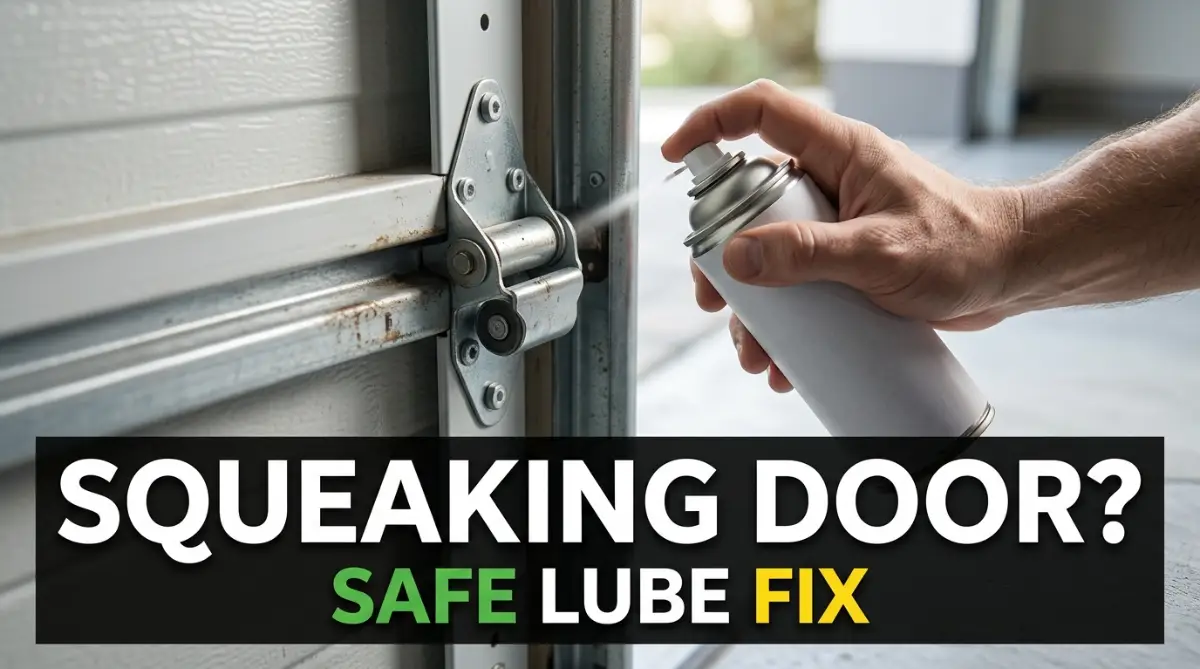
Step 4: Lubricate the hinges
Hinges flex every single time the door moves. On a door that opens twice a day, that’s 700+ cycles per year — without lubrication, they dry out fast.
Where to spray: The hinge pivot point — the cylindrical knuckle where the two hinge halves rotate against each other.
How to do it:
- Hold the spray nozzle about 2 cm from the hinge knuckle
- Give a short 1-second burst
- Move to the next hinge
- After doing all hinges, run the door up and down once to work the lubricant in
- Wipe away any drips with a rag
A standard 7-foot door typically has 10–12 hinges. The whole process takes about 5 minutes.
Tip: If a hinge makes a grinding noise even after lubrication, the knuckle may be worn or cracked — look closely. A replacement hinge costs $3–$5 at any hardware store.
Step 5: Lubricate the rollers (the most common fix)
Rollers are usually the #1 source of garage door squeaking. Most doors have 10–12 rollers, and each one has a bearing that needs lubrication.
First, identify which type of rollers you have:
- Nylon rollers with ball bearings (white or dark grey plastic wheel) — very common on doors made in the last 10–15 years. LiftMaster, Chamberlain, and Genie openers often come with these. Lubricate the bearing area (the metal shaft and bearing housing), NOT the nylon wheel itself.
- Steel rollers (all metal, silver) — found on older doors. Lubricate the bearing area and the axle stem.
- Sealed nylon rollers (no visible bearings) — these technically don’t need lubrication, but a light spray on the axle doesn’t hurt.
How to lubricate rollers:
- Spray directly into the bearing area where the roller meets the axle
- Avoid spraying on the roller wheel surface or inside the track
- Run the door once to distribute
When to replace instead of lubricate: If a roller looks cracked, wobbles side to side, or the bearing feels rough when you spin it by hand, replace it. A set of 10 nylon rollers with bearings (like the Ideal Security SK7100 or similar) costs $15–$25 and is a straightforward swap for most DIYers.
Step 6: Lubricate the opener rail
If the noise seems to come from overhead (from the motor unit area, not the door sides), the opener rail and trolley are likely the source.
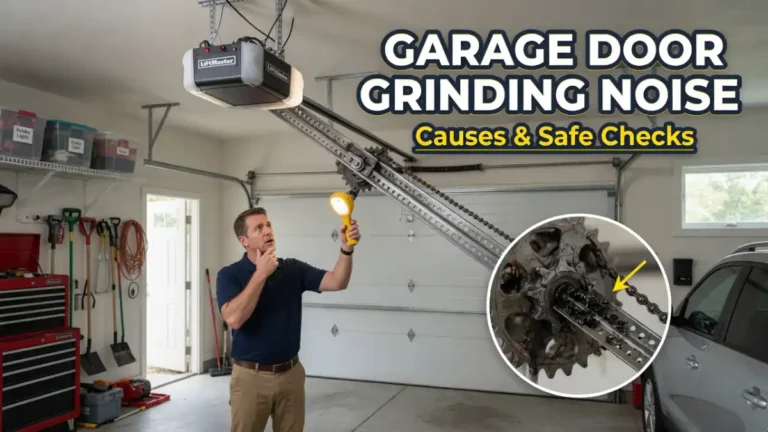
For chain-drive openers (Chamberlain, LiftMaster chain models): Apply a thin coat of white lithium grease along the chain and the rail groove where the trolley slides. Don’t overdo it — a thin coat is enough.
For belt-drive openers (LiftMaster 8550W, Chamberlain B970, etc.): Apply a small amount of lubricant to the trolley carriage where it runs along the rail. The belt itself does not need lubrication.
For screw-drive openers (Craftsman, some older models): These require specific lubrication on the screw threads — check your opener’s manual for the recommended product. Some manufacturers specify a particular grease.
Run the door a few cycles after lubricating to work it in.
Step 7: Check for track rubbing (don’t lubricate the tracks)
This is a common mistake — people spray the inside of the tracks thinking it will help. It does the opposite. Lubricating the tracks makes rollers slip, attracts dirt, and can cause the door to come off track.
Instead, check for rubbing:
- Look at each roller as the door moves. Does any roller tilt or press hard against one side of the track?
- Look for shiny wear marks on the track where a roller is rubbing
- Check if any track section looks slightly bent inward or outward
If the track is dirty: Wipe it with a dry rag or a rag lightly dampened with mineral spirits. Clean tracks help rollers run smoothly.
If you see a bent track or a roller consistently rubbing: This is a mechanical alignment issue that lubrication won’t fix. A technician can usually re-align a track in under an hour for $75–$150, which is worth it compared to a roller or track replacement later.
Step 8: Lubricate the torsion spring (careful — do not adjust it)
The torsion spring above the door can also squeak, especially in dry or cold weather. You can lubricate it safely — but only spray it, never try to adjust or tension it.
Apply a light spray of garage door lubricant along the coils of the spring. Immediately wipe off any excess that drips. Run the door once.
This often eliminates a metallic groan sound that seems to come from the top of the door.
Step 9: When to stop DIY and call a professional
Stop and call a garage door technician if you notice any of the following:
- Door moves jerkily or unevenly — one side lower than the other
- Door feels very heavy when you disconnect the opener and lift by hand (a balanced door should feel like 8–12 lbs)
- You hear a loud bang or pop — this usually means a spring broke
- You see frayed or kinked cables on either side of the door
- A roller has come out of the track
- Noise comes back within a day or two of lubricating — this often means a worn part, not a lubrication issue
Broken torsion springs and cable issues are genuinely dangerous to fix yourself — the springs store enough tension to cause serious injury.
How often should you lubricate a garage door?
For most homes: every 6 months — once in spring before summer heat, and once in fall before cold weather.
In dusty environments (desert areas, near construction), near coastal areas with salt air, or in extreme cold climates: every 3–4 months.
A 6-month lubrication schedule is also a good time to do a visual inspection — check for loose bolts, cracked rollers, worn cables, and clean the tracks.
Brand-specific notes
Chamberlain / LiftMaster: These openers often come with nylon rollers. Chamberlain recommends their own 3-IN-ONE lubricant (available on their website and at Home Depot). For chain-drive models, white lithium grease on the chain is the standard recommendation.
Genie: Genie openers with screw-drive systems require a specific Genie Screw Drive Lubricant (or equivalent). Using the wrong grease on a screw-drive can damage the carriage.
Craftsman: Older Craftsman screw-drive openers require lubrication on the screw threads every 6 months. Newer belt-drive Craftsman openers are similar to Chamberlain (they share manufacturing).
FAQs
Can I use WD-40 on my garage door? Regular WD-40 (blue can) is not a good long-term lubricant for garage doors. It works as a quick fix but evaporates fast. Use WD-40 Specialist White Lithium Grease or a dedicated garage door lubricant instead.
Do I lubricate the tracks? No — never lubricate the inside of the tracks. Tracks should be clean and dry. Lubricate rollers, hinges, the rail, and the spring only.
My door squeaks only in cold weather. Why? Cold temperatures cause metal to contract slightly, which increases friction. Grease also thickens in cold. A thorough lubrication in late fall usually prevents this. If it persists in very cold weather, nylon rollers hold up better than steel in freezing temperatures.
My door still squeaks after lubricating everything. What next? The most likely cause is worn roller bearings. Spin each roller by hand — if any feel rough, gritty, or wobble sideways, replace those rollers. If the noise is from the opener itself (motor area), the internal gears or drive may be worn — that usually means the opener needs service or replacement.
How long does garage door lubricant last? In normal conditions, a proper lubrication lasts 4–6 months. In dusty or coastal environments, reapply every 3 months.
Summary: Quick reference
| Part | Lubricate? | Product |
|---|---|---|
| Hinges | Yes | Lithium grease or garage door lube |
| Rollers (bearing area) | Yes | Lithium grease or garage door lube |
| Tracks (inside surface) | No | Clean only |
| Opener rail/trolley | Yes | Lithium grease |
| Torsion spring | Yes (spray only) | Garage door lube |
| Cables | No | Visual check only |
| Nylon roller wheel | No | Bearing area only |
Last updated: June 2026