Garage Door Opens By Itself: Why It Happens and How to Stop It
A garage door that opens on its own is unsettling — and it’s also a real security risk. Whether it happens at 2am or while you’re sitting in the living room, a self-opening garage door means something in the system is sending an unintended signal.
The good news: in most cases, the cause is something straightforward — a stuck button, a frequency conflict with a neighbor, or a misconfigured limit setting. This guide walks you through every known cause, how to identify which one is affecting your door, and exactly what to do about it.
Quick diagnosis: what’s most likely causing it?
| What you observe | Most likely cause |
|---|---|
| Opens randomly, any time of day | Stuck remote button or frequency interference |
| Opens at a specific time daily | Scheduled timer or smart home automation |
| Opens right after closing | Down-limit or auto-reverse setting problem |
| Opened after a neighbor used their opener | Radio frequency conflict |
| Happens after power outage or storm | Electrical surge or reset issue |
| MyQ app shows activity you didn’t trigger | Someone else has app access, or notification error |
Cause 1: Stuck or shorted remote button
This is the most common cause — and the easiest to fix.
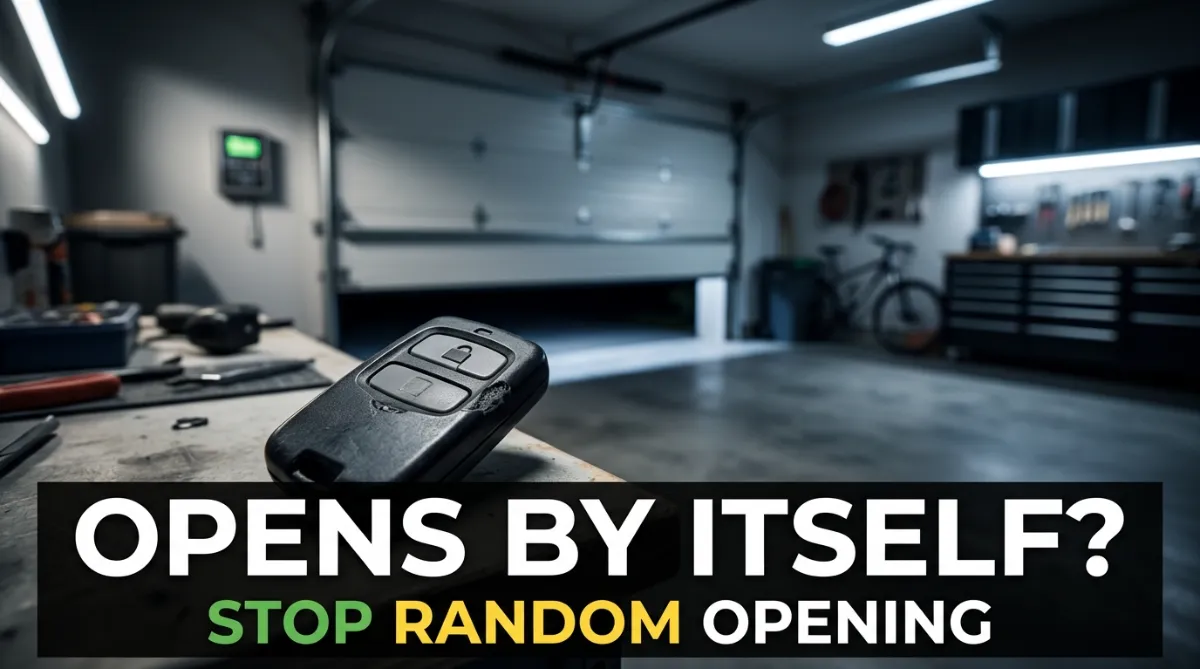
If a remote button is physically stuck down, or the contact inside is shorted (usually from moisture or battery corrosion), it continuously sends an “open” signal to the opener.
How to check:
- Pick up every remote you own — including ones in your car, your glove compartment, and any spares
- Press each button and feel if it springs back cleanly or feels sticky/sunk in
- Look for any sign of moisture damage or battery leak (white or greenish residue near the battery contacts)
Fix:
- Remove the battery from any suspect remote
- If the button is sticky, open the remote case (usually one small screw or a pry-open clip) and clean the contact pad with a dry cotton swab or a bit of isopropyl alcohol
- If the remote has corrosion damage, replace it — remotes cost $15–$30 for most brands (Chamberlain, LiftMaster, Genie)
Important: Check remotes you forgot about. A remote that’s been sitting in a kitchen drawer or under a car seat for months can develop a shorted button.
Cause 2: Radio frequency interference from a neighbor
Older garage door openers (typically pre-2005, and some models up to 2010) use fixed radio frequencies — usually around 300–400 MHz. If a neighbor gets a new opener that happens to share your frequency, their remote can accidentally trigger your door.
This is more common than people realize, especially in newer subdivisions where many doors are installed within a short period.
How to identify this:
- The door opens seemingly at random, but especially when a neighbor leaves or arrives home
- You have an older opener (Chamberlain, LiftMaster, or Craftsman from before 2005)
- The behavior started recently — around the time a neighbor moved in or replaced their opener
Fix for older openers: Most openers from this era have a row of small DIP switches inside the remote and inside the opener’s receiver panel. These switches set the frequency code. You can change the combination on both to a new unique pattern — check your opener’s manual for the switch locations.
Better fix — rolling code upgrade: Openers made after roughly 2005 use Security+ or Security+ 2.0 technology (LiftMaster/Chamberlain), which uses a new code every single press — making frequency conflicts essentially impossible. If your opener is 15+ years old and this is a recurring problem, upgrading to a modern opener is the permanent solution.
Cause 3: Scheduled timer or automation accidentally set
Many modern openers — including LiftMaster 8500W, Chamberlain B970, and MyQ-enabled openers — have a built-in timer feature that can automatically open or close the door at set times.
It’s surprisingly easy to accidentally set a timer, especially when setting up the MyQ app for the first time.
How to check:
- Open the MyQ app → go to your device → look for “Schedules” or “Automations”
- Check your smart home app if you use Google Home, Amazon Alexa, or SmartThings — look for any garage door routines
- On the opener itself, check the wall panel (LiftMaster Smart Control Panel or similar) for any timer indicators
Fix: Delete any schedules or automations you didn’t intentionally set. In the MyQ app: Devices → select opener → Schedules → delete.
Cause 4: Auto-reverse triggering immediately after close
Some garage doors appear to “open by themselves” — but what’s actually happening is the door closes, then immediately reverses and reopens. This looks like a phantom opening but has a different cause.
How to identify this:
- Watch the door carefully — does it go all the way down first, or does it reverse mid-way?
- If it touches the ground and then goes back up, it’s an auto-reverse issue, not a phantom signal
Causes of auto-reverse:
- Down travel limit set too far — the opener thinks the floor is further down than it is and interprets the door hitting the floor as hitting an obstruction
- Sensitivity/force set too high — the opener detects resistance at the floor seal and reverses as a safety measure
- Something physically blocking the path — debris, a mat, an uneven floor surface
Fix:
- Adjust the down travel limit using the adjustment screws or buttons on the opener unit (usually labeled “Down” and “Up” — check your model’s manual)
- For Chamberlain/LiftMaster: there are two small adjustment screws on the back or side of the motor unit. Turn the “Down” limit screw slightly counterclockwise (reduces travel distance) in small increments
- For Genie openers: use the up/down limit buttons on the wall console
- Test after each small adjustment
If it reverses mid-way before touching the ground, check for something in the door’s path, or a sensor issue.
Cause 5: Wall button wiring short
The wall button inside your garage is connected to the opener by a low-voltage wire. If this wire gets pinched, chewed by a rodent, or develops a short from a staple that was nailed through it during installation, it can send a continuous or intermittent signal — just like a stuck button.
How to check:
- Visually trace the wire from the wall button to the opener motor unit
- Look for any point where the wire is pinched under a door frame, stapled through (rather than over), or shows any damage
- Temporarily disconnect the wall button wires from the opener terminal and see if the phantom opening stops
Fix:
- Replace the section of wire that’s damaged with standard 22-gauge two-conductor wire (available at any hardware store for ~$5–$10 per roll)
- If a staple is through the wire, gently remove it and cover the spot with electrical tape before replacing
Cause 6: Neighbors or family members with app access
If your opener is MyQ-enabled or connected to a smart home system, anyone who was ever given access to the app can open your door remotely — even if you’ve forgotten you gave them access.
How to check in MyQ:
- Open the MyQ app → tap the three-line menu → “Manage Users” or “Share Access”
- Review who has access — remove anyone who shouldn’t
Also check:
- If you sold a previous home or car that had the opener programmed to a HomeLink system, the new owner’s HomeLink may still be able to open your door if you never erased the opener’s memory
Fix for this: Clear the opener’s full memory (all remote and HomeLink codes) and re-program only the devices you currently use. Instructions for this are usually on the back of the motor unit or in the manual — look for a “Learn” button and hold it for 6–10 seconds until the indicator light goes out.
Cause 7: Electrical surge or power issue
A power surge, brownout, or brief power outage can sometimes cause a garage door opener to briefly activate — either during the surge or when power is restored.
This is more common with older openers that don’t have surge protection built in.
How to identify this:
- The phantom opening happened during or just after a storm
- It happened once and hasn’t repeated
- You’ve noticed other electronics acting strangely at the same time
Fix:
- Plug the opener into a surge protector power strip (not just a regular extension cord)
- If this happens repeatedly during storms, a whole-home surge protector installed at your electrical panel offers the best protection (~$200–$400 installed by an electrician)
- A one-time occurrence after a power event usually doesn’t need further action
Cause 8: The opener’s logic board is failing
If you’ve ruled out all of the above and the door continues to open randomly, the opener’s main circuit board may be malfunctioning. This is more common on openers that are 10–15+ years old.
Signs that the logic board is the issue:
- Random behavior that doesn’t match any pattern
- Other functions acting strangely (lights flickering, beeping without cause)
- Door opens AND closes randomly, not just opens
A replacement logic board for most LiftMaster and Chamberlain openers costs $40–$80 and can be swapped out in about 20 minutes — just unplug the opener, swap the board, and plug it back in. Search your model number + “logic board” to find the right part.
However, if your opener is over 12 years old, replacing the full opener is often more cost-effective. A new Chamberlain B2405 or LiftMaster 81550 runs $150–$200 and comes with modern security features, battery backup, and MyQ connectivity.
Immediate security steps if you can’t fix it right now
If your door is opening by itself and you can’t troubleshoot it immediately, take these steps:
- Disconnect the opener — pull the red emergency release cord hanging from the trolley. This physically disconnects the door from the opener. The door can still be opened manually, but the opener won’t move it automatically.
- Use the door lock — most garage doors have a manual slide lock on the inside. Engage it.
- Unplug the opener from the ceiling outlet until you can investigate
Do not ignore a self-opening garage door — it’s a security vulnerability.
Brand-specific notes
LiftMaster / Chamberlain (Security+ 2.0 openers): These use rolling code technology, so frequency conflicts with neighbors are not an issue. If your LiftMaster opens by itself, focus on wall button wiring, MyQ schedules, or the logic board.
Genie openers (Intellicode): Genie’s Intellicode system also uses rolling codes. Check the Aladdin Connect app (Genie’s smart home platform) for any scheduled activity.
Craftsman openers: Older Craftsman openers (pre-2010, made before the Chamberlain partnership) used fixed DIP switch codes. If you have one of these and a neighbor recently got a new opener, frequency conflict is a real possibility.
Ryobi / Overhead Door / Wayne Dalton: Check manufacturer app for any automation or schedule settings before assuming a hardware fault.
FAQs
Can a garage door open by itself due to weather? Indirectly, yes. A lightning strike nearby can cause a power surge that triggers the opener. Cold weather can cause wall button contacts to behave erratically. But weather doesn’t directly cause a door to open — it triggers one of the electrical causes listed above.
My garage door opens every day at the same time. What is it? This is almost certainly a scheduled timer in your opener’s settings or in a connected smart home app. Check MyQ, Google Home, Alexa routines, or SmartThings automations.
Could a radio or TV cause my garage door to open? Very rarely, and almost exclusively with very old openers using unencrypted fixed frequencies. Modern openers (post-2005 with rolling codes) are not affected by this.
My garage door opened while I was away. How do I know who opened it? If you have a MyQ-enabled opener, the app logs every open and close event with a timestamp and shows which user or device triggered it. Go to MyQ app → your device → Activity History.
I’ve checked everything and it still opens randomly. Now what? Replace the logic board or the full opener. At this point, a hardware failure is the most likely cause. For openers over 10 years old, a full replacement is usually the better investment.
Summary checklist
Work through these in order — most cases are solved by step 3 or 4:
- [ ] Check all remotes for stuck buttons or corrosion damage
- [ ] Remove batteries from all remotes temporarily and observe for 24 hours
- [ ] Check MyQ app and smart home apps for scheduled automations
- [ ] Watch the door close — does it touch the floor and reopen? (travel limit issue)
- [ ] Inspect wall button wiring for damage or pinching
- [ ] Check MyQ “Manage Users” for unwanted access
- [ ] Erase opener memory and re-program remotes if you recently bought the home or car
- [ ] Plug opener into surge protector
- [ ] Test logic board or consider replacement if all else fails
Last updated: June 2026